

We're down in the valley below the moat.
But even more impressive - a Roman Aqueduct from 50 BC. You can see part of the start of it behind me. They've preserved about 200yds from the start to the point where it goes underground and runs across town to the Alcazar...about 10 miles altogether.


Most of the ancient wall still exists behind three gates. Here's the first one:


And there's the beautiful cathedral

Along with some terrifically well-preserved medieval buildings


Like most of the architecture we've seen, there are several influences at work: Moor, Roman, Christian...it's a real melting pot. But as wonderful as the castle and surrounds are, the real star of the show is the aqueduct. I guess that's what unlimited slave labor and materials can do for you!


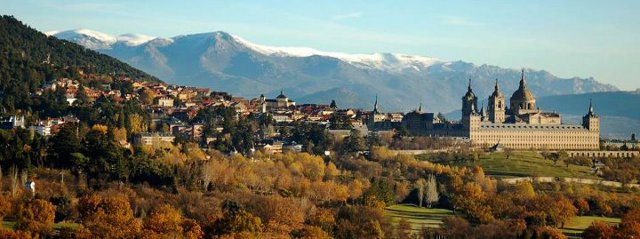
We left Segovia and backtracked to El Escorial, a royal palace, and the burial place of all but two of Spain's Kings, nobles, and VIPs in the past 800 years.

It's unfortunate that we couldn't take pictures inside, but the edifice contains a basilica, a pantheon, a monastery, a private school, a palace, and a library. You can check out some of the inside here.
At the end of the day, we headed back to Madrid for a dinner of tapas. It's our last night here. Tomorrow we take a train to Barcelona.
Another BTW: In Toledo, we kept seeing images of Don Quixote. While neither Don Quixote nor Cervantes have anything to do with Toledo, about 35 miles outside of the city there is a large plain called the Castilla de la Mancha. It's home to windmills, as well as vineyards, olive groves, farms, pastures, etc. And, of course, it's the setting for Man of La Mancha. Castilla de la Mancha is part of an autonomous community (what we would call states), and Toledo is its capital. Milk it for all it's worth, I guess!

No comments:
Post a Comment